The Growing Role of AI in Modern Game Development
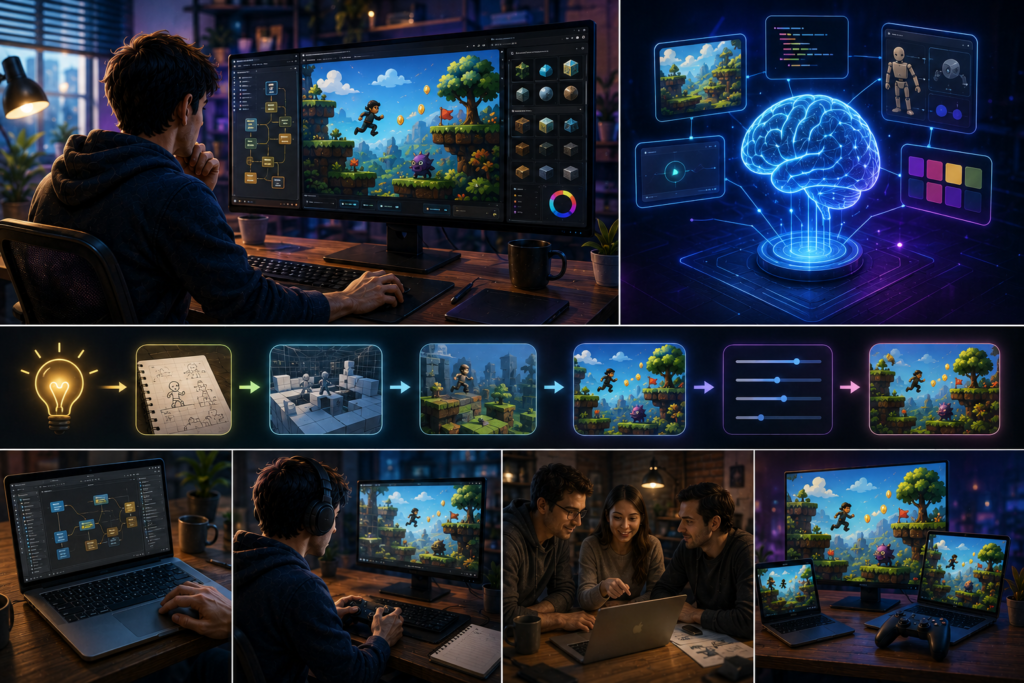
A role that’s growing is different from a role that’s already fixed in place. AI’s involvement in game development isn’t a settled fact, it’s an expanding presence, showing up in more stages of the process, for more kinds of creators, than it did even a short time ago. Tracking where that growth is actually happening, rather than treating AI as a single static tool, gives a clearer picture of where development is genuinely heading.
From a Narrow Tool to a Broader Presence
Early AI Involvement Was Limited and Specific
AI’s first meaningful roles in game development were narrow: generating placeholder art, suggesting simple level layouts, handling isolated technical tasks. Useful, but contained to specific corners of the process rather than touching the overall workflow.
The Role Has Expanded Significantly
That narrow involvement has grown into something far more central. AI now participates in translating entire concepts into working prototypes, supporting iterative design decisions, and enabling solo creators to cover ground that used to require multiple specialized roles. The scope of what AI touches within a typical project has genuinely widened.
Where AI’s Role Is Growing Most Visibly
From Prototyping Assistance to Prototyping Foundation
AI used to help speed up specific parts of building a prototype. Now, for many creators, it’s the foundation the entire prototype is built on. Game maker online platforms take a plain-language description and generate the working structure directly, shifting AI from a supporting tool to the primary mechanism through which many first drafts come into existence.
From Solo Task Support to Full-Project Involvement
Where AI once handled isolated tasks within a larger manually-driven project, it’s now involved across nearly the entire development lifecycle for many creators, initial prototyping, iteration, asset generation, and ongoing refinement based on playtest feedback. Games like Spiderman: Spin Strike Heroes reflect what that kind of comprehensive, AI-supported process can produce, a fast, satisfying core loop that likely benefited from AI involvement at multiple stages rather than just one isolated part of development.
From Individual Creators to Small Studios
AI-assisted development started as a tool primarily associated with solo hobbyists and first-time creators. Its role has grown to include small professional studios using these tools throughout their production pipeline, not as a novelty, but as a genuine part of how they build and iterate on projects meant for real commercial release.
Why This Role Keeps Expanding
Each Improvement Builds on the Last
As natural language understanding and generation quality improve, AI becomes capable of handling a wider range of tasks reliably, which naturally expands where developers are willing to rely on it. This creates a compounding effect: today’s improvements make tomorrow’s expanded role possible.
Developers Are Building Trust Through Results
Early skepticism about whether AI-assisted development could produce genuinely good results has given way to a large and growing body of evidence that it can. That accumulated trust is part of why AI’s role keeps expanding into more serious, higher-stakes projects rather than staying confined to casual experimentation.
Competitive Pressure Encourages Broader Adoption
As more creators successfully use AI throughout their development process and ship strong results faster, others face growing pressure to adopt similar approaches simply to stay competitive on speed and iteration capacity. That pressure itself expands AI’s role across the industry.
What This Growing Role Looks Like in Practice
Earlier Involvement in the Creative Process
AI is increasingly present from the very first moment of translating a raw idea into something testable, rather than being introduced later to help with production tasks once a design was already largely determined through other means.
Deeper Involvement in Iteration
Beyond initial creation, AI’s role has grown to support the iterative refinement process itself, generating variations for comparison, implementing adjustments based on playtest feedback, and supporting the kind of rapid, repeated testing that used to require significant manual effort at each step.
Broader Involvement Across Skill Levels
What started as primarily useful for non-programmers has grown to include experienced developers who use AI-assisted tools for rapid prototyping even when they’re fully capable of implementing something manually, simply because the speed advantage remains valuable regardless of existing technical skill.
What Isn’t Growing, and Why That Matters
AI’s Role in Creative Vision Remains Unchanged
Despite AI’s expanding involvement in execution, its role in generating the underlying reason a game concept is worth pursuing hasn’t grown at all. That remains entirely a human contribution, and there’s no clear technical path toward that changing.
The Need for Human Evaluation Isn’t Shrinking
As AI takes on more of the implementation work, the relative importance of human judgment in evaluating whether the results are actually good hasn’t diminished, if anything, it’s become the primary bottleneck determining whether a project succeeds, since execution is no longer the limiting factor it once was.
Community and Player Relationships Remain Fully Human
AI’s growing role in building and refining games hasn’t extended meaningfully into the relationship-building that turns a released game into a sustained success, understanding a specific audience, responding to community feedback, and building trust with players remain entirely human undertakings.
What This Growth Suggests Going Forward
Expect AI Involvement Earlier and More Continuously
As tools continue improving, AI’s presence is likely to keep moving earlier into the creative process and remain continuously involved throughout, rather than being introduced at discrete, separate stages.
Expect the Line Between AI-Assisted and Traditional Development to Blur Further
As more experienced, traditionally-trained developers incorporate AI-assisted tools into their normal workflow, the distinction between “AI-assisted” and “traditional” development is likely to matter less over time, becoming simply how development gets done rather than a separate category.
Final Thoughts
The growing role of AI in modern game development reflects genuine expansion, not a fixed capability that’s just becoming more popular. AI’s involvement has moved from narrow, isolated tasks to a much broader presence across the creative process, adopted by an increasingly wide range of creators, from complete beginners to experienced studios.
What hasn’t grown, and shows no sign of growing, is AI’s role in creative vision and human judgment, the parts of development that determine whether a game is actually worth playing. As AI’s role continues expanding into execution, that human judgment becomes more central to what actually separates good games from mediocre ones, not less.