Enneagram Stress and Growth: How Each Type Moves
No personality is fixed. Under pressure, each Enneagram type starts to borrow the unhealthier habits of another type; when growing and secure, it takes on the healthier qualities of a different one. These movements are mapped as the Enneagram’s arrows — directions of stress (disintegration) and growth (integration) — and they explain why a person can seem like a different type in different seasons of life. Learning your own arrows turns the Enneagram from a static label into a practical map of change.
What the Arrows Mean
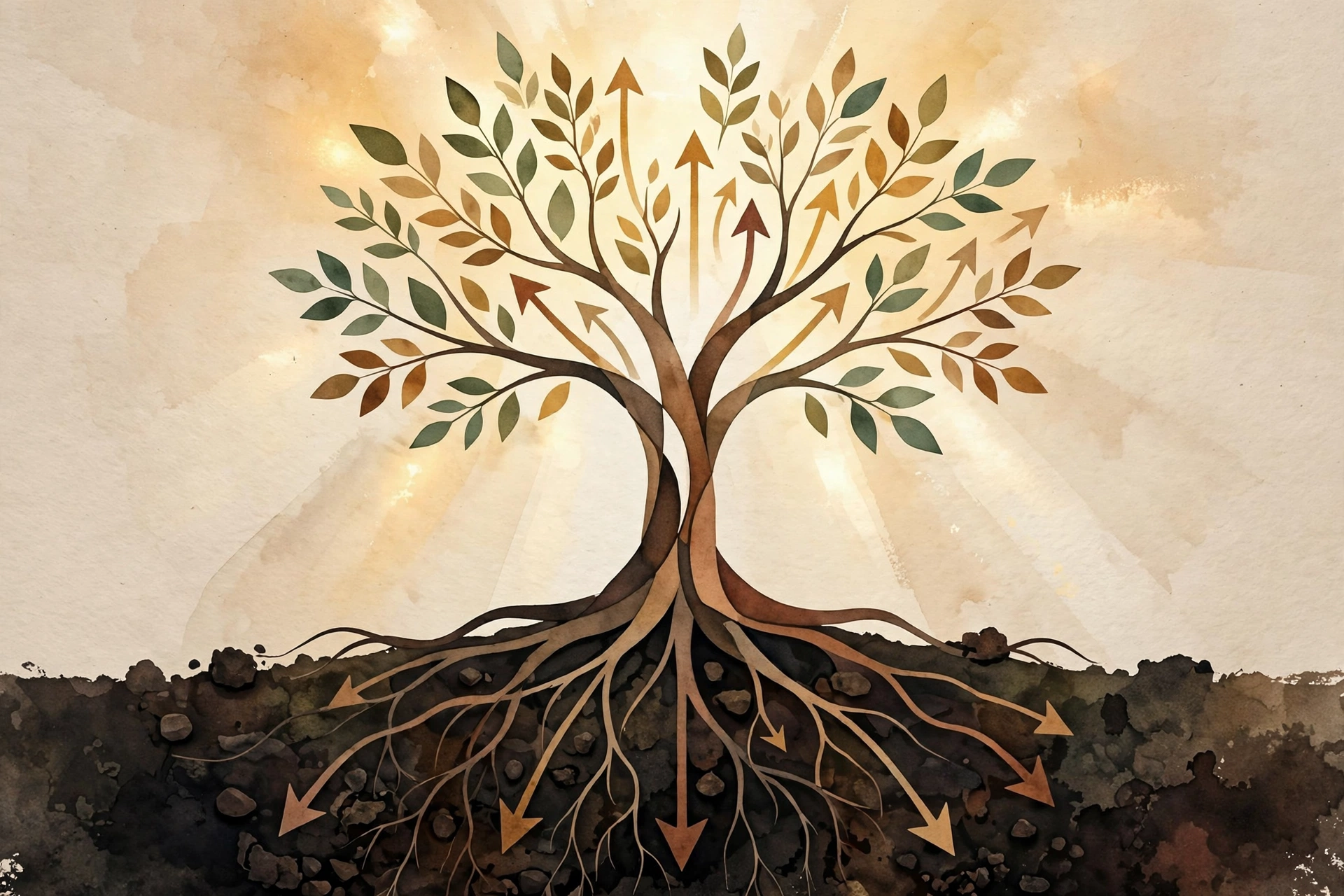
On the Enneagram diagram, each type connects to two other types by lines. One line points in the direction the type moves under stress and overwhelm; the other points in the direction it moves when secure, relaxed, and developing.
- Direction of stress (disintegration): The unhealthy traits a type picks up when exhausted, frightened, or cornered. Stress behavior is not “fake” — it is a real pattern that shows what the type does when its usual strategies stop working.
- Direction of growth (integration): The healthy qualities a type develops as it matures. Growth behavior emerges when the type’s core fears loosen and it can borrow strengths it usually resists.
Importantly, stress movement is not a destination and growth movement is not a reward ceremony. People cycle through these movements continuously. Recognizing the pattern in real time is the actual skill — noticing “I’m acting like an unhealthy Four right now” gives a stressed Type One a way back before things spiral.
The Direction of Stress for Each Type
When overwhelmed, each type gravitates toward the average-to-unhealthy traits of its stress type:
- Type One moves to Four (stress): The principled reformer becomes moody, self-absorbed, and irrationally self-critical, wallowing in feelings of defectiveness instead of fixing problems.
- Type Two moves to Eight (stress): The generous helper becomes controlling, demanding, and confrontational, insisting that others meet their needs after years of silent giving.
- Type Three moves to Nine (stress): The driven achiever becomes disengaged, apathetic, and numb, shutting down and going through the motions when success feels hollow or unattainable.
- Type Four moves to Two (stress): The introspective individualist becomes clingy and over-involved, chasing others for validation and trying to earn love through service.
- Type Five moves to Seven (stress): The detached observer becomes scattered, impulsive, and frenetically distracted, jumping between activities to avoid an overwhelming problem.
- Type Six moves to Three (stress): The loyal skeptic becomes image-focused and workaholic, throwing themselves into busyness and appearances to outrun anxiety.
- Type Seven moves to One (stress): The spontaneous enthusiast becomes rigid, critical, and perfectionistic, clamping down on themselves and others when freedom fails to fix the pain.
- Type Eight moves to Five (stress): The assertive challenger becomes withdrawn, secretive, and over-analytical, retreating into the mind when direct confrontation stops working.
- Type Nine moves to Six (stress): The easygoing peacemaker becomes anxious, suspicious, and reactive, suddenly seeing threats everywhere after long suppression of their own concerns.
Notice the pattern: stress behavior looks like the worst version of the neighboring type’s strategy. A stressed Two doesn’t become a generic mess — they become specifically Eight-like in their demanding directness, which their usual self would never permit.
The Direction of Growth for Each Type
When secure and developing, each type takes on the healthiest qualities of its growth type:
- Type One moves to Seven (growth): The reformer becomes spontaneous, playful, and joyful, learning that imperfection can be enjoyed rather than corrected.
- Type Two moves to Four (growth): The helper becomes introspective and emotionally honest, attending to their own inner life instead of only serving others.
- Type Three moves to Six (growth): The achiever becomes loyal, cooperative, and sincere, finding worth in commitment to people and causes rather than applause.
- Type Four moves to One (growth): The individualist becomes disciplined and principled, turning emotional depth into consistent, constructive action.
- Type Five moves to Eight (growth): The observer becomes decisive and embodied, bringing knowledge into the world with confidence instead of hoarding it.
- Type Six moves to Nine (growth): The skeptic becomes calm, trusting, and accepting, resting in faith that things can work out without constant vigilance.
- Type Seven moves to Five (growth): The enthusiast becomes focused, thoughtful, and deep, finding satisfaction in sustained attention rather than novelty.
- Type Eight moves to Two (growth): The challenger becomes caring and tender, using strength to protect and nurture rather than dominate.
- Type Nine moves to Three (growth): The peacemaker becomes energetic and self-developing, pursuing their own goals with the drive they usually reserve for others.
Growth is not about becoming a different type — a growing Eight is still an Eight, but an Eight who has integrated the Two’s capacity for genuine tenderness.
How to Tell Stress From a Mistype
A common confusion: “I acted like a Four under stress — am I actually a Four?” Probably not. Stress behavior is temporary, reactive, and feels foreign or embarrassing to the person. Your core type is the pattern you return to at rest, the one whose fears motivate your everyday choices even on good days.
Ask these questions to distinguish:
- Is it chronic or situational? Core type patterns persist for years; stress patterns flare during crises and fade.
- Does it feel natural or compulsive? Your own type’s habits feel like “just how I am”; stress behaviors feel like a loss of control.
- What are you afraid of? Core fears (being wrong, being unloved, being worthless, and so on) point to the core type, not the arrow.
Using the Arrows for Personal Growth
The arrows are most useful as an early-warning and development system. Here is a practical approach:
- Learn your stress signature. Memorize the two or three hallmark behaviors of your stress type so you can recognize them in yourself. For a One, the signature is brooding self-absorption; for a Seven, it’s rigid criticism.
- Catch it early. The moment you notice stress behavior, name it: “I’m in my stress pattern.” Naming interrupts the autopilot.
- Address the real cause. Stress behavior is a symptom. Ask what pressure, fear, or unmet need triggered the move, and deal with that directly.
- Practice your growth direction deliberately. Growth qualities can be cultivated before a crisis. A Two can practice naming their own feelings daily (Four-like honesty); a Nine can set and pursue one personal goal weekly (Three-like initiative).
- Track patterns over months. Keep a simple note of when you moved along each arrow. Over time, you’ll see your personal triggers and your genuine progress.
A useful companion to this work is understanding which instinct drives you most strongly, since your dominant instinct shapes where stress shows up first — read our guide to the three Enneagram instincts for the full picture.
Stress and Growth in Relationships
The arrows also explain relationship dynamics. When one partner moves into stress, the other often reacts with their own stress pattern, creating a spiral: a stressed Two becomes demanding (Eight-like), which triggers their partner’s defensive withdrawal, which confirms the Two’s fear of being unloved. Couples who know each other’s arrows can interrupt these loops by naming what’s happening — “You’re in your Eight right now; what do you actually need?” — instead of reacting to the surface behavior.
In healthy periods, partners can also consciously support each other’s growth directions: encouraging the Four toward disciplined action (One-like growth) or giving the Five room to be boldly decisive (Eight-like growth).
The Arrows Are Not Boxes
Two cautions keep this model honest. First, the arrows describe tendencies, not destinies — a Type Three under pressure might look Nine-like, but so can simple exhaustion, depression, or burnout, which are human conditions, not type movements. The Enneagram never replaces attention to mental health; if stress patterns are severe or persistent, professional support matters more than type theory.
Second, growth along the arrows is gradual. Nobody “completes” integration. The healthiest people of any type still have their core fears; they’ve simply built wider responses to them. The arrows give those responses a direction to practice, which is more useful than any label.
Frequently Asked Questions
Do I move to my stress type permanently if life stays hard?
No. Even under prolonged pressure, the movement is a pattern, not a transformation. People cycle in and out of stress behavior as circumstances shift, and they return to their core type’s strategies when pressure eases.
Can I skip my stress type and go straight to growth?
Growth isn’t a bypass. Trying to force growth behavior while ignoring real stress usually backfires. The reliable path is to acknowledge stress, address its cause, and then practice the growth qualities deliberately.
Are the arrows the same as wings?
No. Wings are the neighboring numbers on the diagram (a Three with a Two wing, for example) and they flavor the core type continuously. Arrows are separate lines connecting non-adjacent types, and they describe movement under changing conditions rather than a constant flavor.
Why does my growth type seem like the opposite of me?
That’s exactly the point. The growth direction offers what your type habitually avoids: Ones avoid playfulness, Fours avoid discipline, Eights avoid vulnerability. The qualities feel foreign at first because they challenge the type’s core strategy.
How long does it take to notice my arrows in real time?
Most people need several weeks of deliberate observation. Journaling specific moments — “today I was scattered and impulsive like a stressed Seven” — speeds the process considerably.
Where can I study the classic arrow theory in depth?
The foundational descriptions of integration and disintegration for all nine types are maintained by The Enneagram Institute, the most established reference for traditional Enneagram teaching.