Color Personality Test: What Your Color Says About You
Have you ever wondered why you are instantly drawn to a fiery red jacket while your best friend picks calm blue every time? It is not random. Psychologists and personality researchers have long believed that color preferences reveal something real about who we are — and the color personality test turns that idea into a simple, fun, and surprisingly revealing assessment.
A color personality test sorts you into a color group based on your answers to a short set of questions. Each color stands for a cluster of traits: how you communicate, what motivates you, how you handle stress, and what you need from relationships. Companies use these tests for team building, couples use them to understand each other, and millions of people take them just for the fun of self-discovery.
In this guide, we will explain how color personality tests work, walk through the two most popular systems, break down what each color really means, and show you how to use your result in real life.
What Is a Color Personality Test?
A color personality test is a type of psychometric quiz that assigns you a color based on your personality traits. Instead of giving you a complex four-letter code or a long numerical profile, it simplifies your personality into an intuitive color — something you can remember and talk about instantly.
The test usually works like this:
- You answer a series of questions or word rankings about your habits, values, and reactions.
- Each answer is scored toward one of four color categories.
- Your dominant color becomes your “personality color,” though most people are a blend of two.
The appeal is obvious: colors are visual, emotional, and easy to share. Saying “I’m a Gold” or “I’m a Blue” is much more approachable than reciting a personality-type code at a dinner party.
The Two Most Popular Color Test Systems
Not all color personality tests are the same. Two systems dominate, and understanding the difference matters because the same color name can mean different things in each one.
The True Colors System
Created by Don Lowry in 1978, True Colors sorts people into four temperaments: Orange, Gold, Green, and Blue. It is rooted in the classic temperament theory that goes back to Hippocrates and was refined by psychologists like David Keirsey. True Colors is one of the most widely used color tests in schools, workplaces, and team-building workshops around the world.
The Color Code System
Developed by Dr. Taylor Hartman, the Color Code uses Red, Blue, White, and Yellow. Unlike True Colors, which focuses on learned behavior and temperament, the Color Code claims to measure your innate, core personality — the “why” behind what you do rather than just the “what.” Hartman’s system is especially popular for relationship counseling and personal development.
What Each Color Means
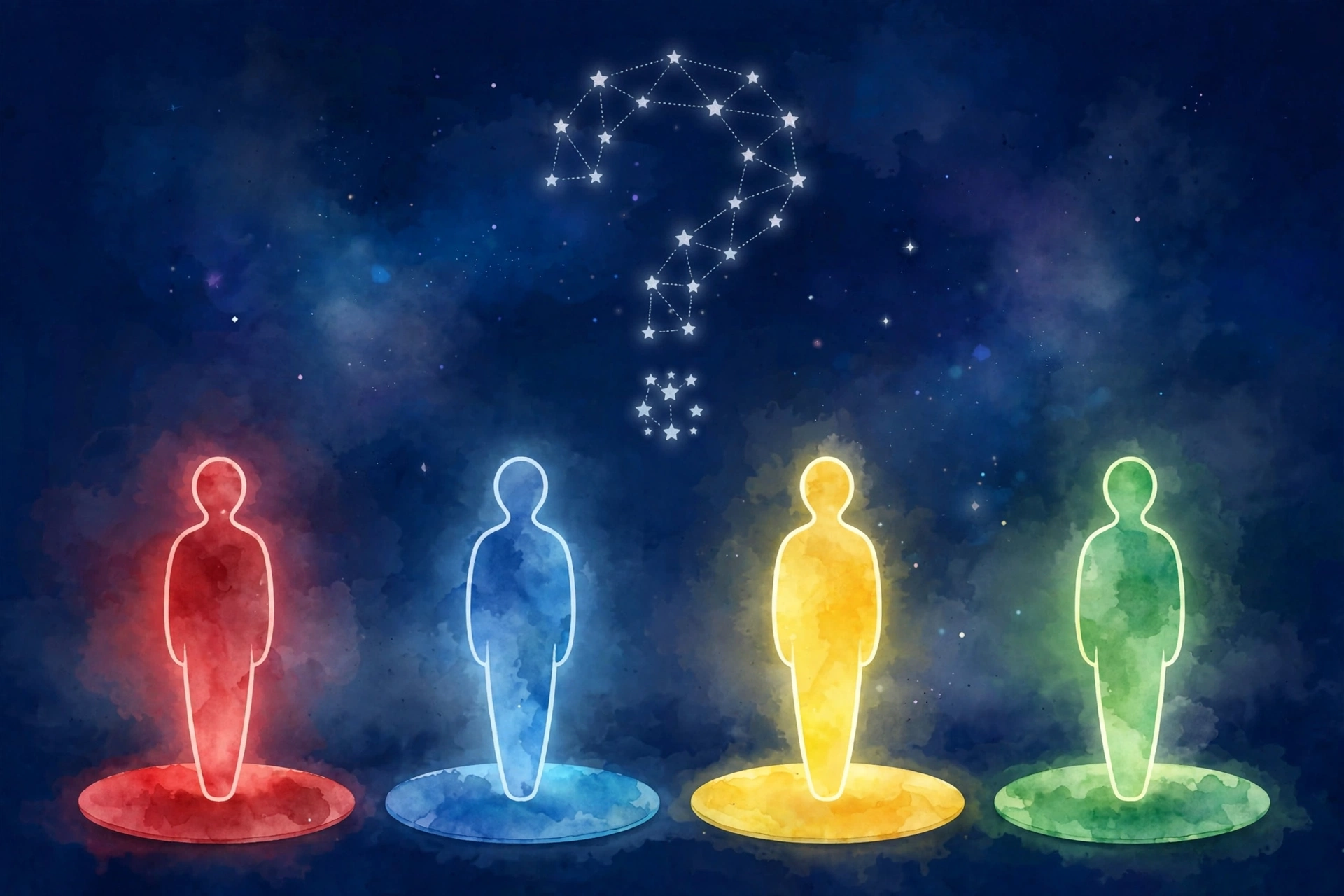
Below is a breakdown of the colors from both systems, so you can see where you fit regardless of which test you take.
True Colors Meanings
- Orange — the Adventurer. Oranges are spontaneous, energetic, and hands-on. They love action, variety, and competition. They tend to be playful risk-takers who perform best under pressure and hate being bored or tied down by routine.
- Gold — the Organizer. Golds value structure, responsibility, and tradition. They are dependable, loyal, and detail-oriented. They keep the trains running on time and feel stressed when plans fall apart.
- Green — the Thinker. Greens are analytical, curious, and independent. They love solving complex problems, questioning assumptions, and mastering new ideas. Small talk bores them; deep conversation energizes them.
- Blue — the Helper. Blues are warm, empathetic, and relationship-driven. They value authenticity, harmony, and personal growth. They are the friends who remember your birthday and notice when you are upset before you say a word.
Color Code Meanings
- Red — the Leader. Reds are driven, decisive, and strong-willed. They need to look competent, be right, and be respected. They are natural leaders who love challenges and get frustrated by inefficiency.
- Blue — the Connector. Blues seek integrity and deep connection. They are focused on quality, loyalty, and creating meaningful relationships. They worry more than other colors and take criticism personally.
- White — the Peacemaker. Whites are calm, logical, and tolerant. They need to be accepted and treated with kindness. They avoid confrontation, make excellent listeners, and can appear detached when they are simply processing quietly.
- Yellow — the Optimist. Yellows are fun-loving, spontaneous, and social. They need to be noticed and enjoy life. They bring energy to every room but can struggle with follow-through and organization.
How to Take a Color Personality Test
Taking a test is quick and free. Here is how to get the most accurate result:
- Answer honestly, not ideally. Pick the answer that describes how you actually behave, not how you wish you behaved. There are no “better” colors — each has strengths and blind spots.
- Go with your first instinct. Overthinking each question skews your results toward the person you think you should be.
- Take it when you are calm. Answering while stressed or in a bad mood can push your result toward your “stress color” rather than your true one.
- Remember your secondary color. Most people have a clear dominant color plus a strong secondary. That combination — like “Gold with Orange” — gives a much richer picture than one color alone.
- Retake it after major life changes. Your core personality is stable, but how you express it can shift. Retaking the test every year or two keeps your self-knowledge fresh.
Color Tests vs. Other Personality Assessments
How does a color test stack up against better-known assessments? Each has its place:
- MBTI: The Myers-Briggs Type Indicator is far more detailed, sorting you into one of 16 types with cognitive functions. It takes longer and digs deeper. If you enjoy the color test, the MBTI personality test is a great next step for a more granular profile.
- Enneagram: This system focuses on core motivations and fears, with nine types. It is excellent for personal growth work but more complex to learn.
- DISC: Popular in corporate settings, DISC measures dominance, influence, steadiness, and conscientiousness. It is similar in spirit to color tests but less colorful and memorable.
- StrengthsFinder: This measures your top talents rather than your personality style. It pairs well with a color test for career planning.
Color tests win on simplicity and memorability. They are the perfect entry point into personality psychology — easy to take, easy to share, and easy to apply the same day.
Practical Uses: Teams, Relationships, and Careers
Color personality results are more than a party trick. Here is how people actually use them:
- Team building: Managers use color results to build balanced teams, assign roles that fit natural strengths, and defuse conflicts by explaining differences in communication style.
- Romantic relationships: Couples learn why one partner craves planning while the other craves spontaneity. Knowing your partner is a “White” who needs space to process can prevent a lot of arguments.
- Parenting: Understanding your child’s color helps you motivate them effectively. A Yellow child responds to fun and encouragement; a Gold child responds to structure and praise for responsibility.
- Career choices: Blues often thrive in counseling, teaching, and healthcare. Reds gravitate toward leadership, sales, and entrepreneurship. Greens excel in research, engineering, and strategy.
- Communication: Once you know someone’s color, you can frame your message to land. Need something from a Gold? Be organized and specific. Talking to an Orange? Keep it brief and exciting.
What the Science Says
Let us be honest: color personality tests are not diagnostic instruments. They are based on temperament theory and clinical observation, not on the kind of large-scale validation behind tools like the Big Five. Psychologists caution that any self-report quiz can be influenced by mood, self-image, and the desire to look good.
That said, the underlying trait clusters are real. The four True Colors map closely onto well-researched personality dimensions, and millions of people report that their results feel strikingly accurate. The value of these tests is practical: they give you a shared language for talking about differences, and that alone improves communication.
Think of a color personality test as a starting point, not a final verdict. Use it to spark curiosity about yourself and others, then explore deeper assessments if you want more precision.
If you want to try the other major system, you can take a free version of Dr. Hartman’s assessment on the official Color Code website and compare your result with the True Colors framework above.
Frequently Asked Questions
Which color personality test is the most accurate?
There is no single “most accurate” test, but the two most respected systems are True Colors (Orange, Gold, Green, Blue) and Taylor Hartman’s Color Code (Red, Blue, White, Yellow). Both are widely used in professional settings. For the most reliable result, answer honestly and take the test when calm.
Can my color change over time?
Your core personality is fairly stable, but your results can shift with major life changes, stress, or personal growth. Many people find their dominant color stays the same while their secondary color evolves. Retake the test every year or two if you want to track changes.
What is the rarest color personality?
It depends on the system and the population tested, but in True Colors, Greens are often the least common in the general population, while in the Color Code, Whites are sometimes reported as the rarest. Remember that rarity does not mean better — every color has valuable strengths.
Are color personality tests scientifically valid?
They are based on temperament theory and clinical observation rather than rigorous psychometric validation like the Big Five. Psychologists consider them useful self-reflection and communication tools, not diagnostic instruments. Take the results as insight, not destiny.
What color personality is best for leadership?
Every color can lead, but each leads differently. Reds lead with drive and decisiveness, Golds with organization and reliability, Greens with vision and logic, and Blues with empathy and inspiration. The best leaders understand their own color and adapt to the colors of their team.
Final Thoughts
The color personality test proves that self-discovery does not have to be complicated. In ten minutes, you can gain a vocabulary for understanding why you tick the way you do — and why the people around you tick differently.
So take the test, share your color with a friend, and start noticing the Reds, Blues, Whites, Yellows — or Oranges, Golds, Greens, and Blues — in your own life. You might be surprised how much one little color can explain.